

Rasuwa, a Himalayan district renowned for its natural beauty and tourism, is now gaining recognition as a center for scientific agriculture. Cold-water fish farming has opened new economic opportunities in the region.
The Rainbow Trout Fish Research Center, operating near Imrung close to the district headquarters Dhunche, has successfully supplied trout fingerlings as far as Darchula in the far-western region, marking a significant milestone in Himalayan agricultural transformation.
Traditionally, fish farming in Nepal was limited to the Terai region. The center has now provided scientific proof that trout farming is feasible in high-altitude Himalayan areas. Rainbow trout were introduced to Nepal about five decades ago, and after extensive scientific testing and foreign collaboration, they were found suitable for cold Himalayan waters, paving the way for commercial farming. Starting in Bokejhunja, trout farming has now expanded across several locations in Rasuwa.
Since 2014, the Dhunche center has systematically produced fingerlings. What began as small-scale trials has now expanded nationally, with trout fingerlings from Rasuwa reaching more than 27 districts, including Darchula, Baitadi, Mugu, Jumla, Kalikot, Parbat, Rukum East and West, Gulmi, Myagdi, Baglung, Kaski, Gorkha, Dhading, Makwanpur, Lalitpur, Kathmandu’s Sankharapur, Sindhupalchok, Kavre, Ramechhap, Dolakha, Solukhumbu, Tehrathum, Taplejung, and Nuwakot.
According to Chief Scientist Mahendra Prasad Bhandari, the center has expanded production in response to farmers’ demand. As the only government-run Rainbow Trout Research Center in the country, it provides integrated services from egg production to fingerling distribution and technical training.
The center not only produces fish but also imparts scientific knowledge and skills to farmers. Trout farming has spread across several areas in Rasuwa, including Nagung, Bokejhunja, Sole, Thulobharkhu, Baharghumti, Gatlang, Goljung, and Nesing.
Amidst rising unemployment and youth migration from Himalayan villages, trout farming is creating local opportunities. Fingerlings produced at the center have even been exported to Bhutan, marking an important achievement in Nepalese fisheries.
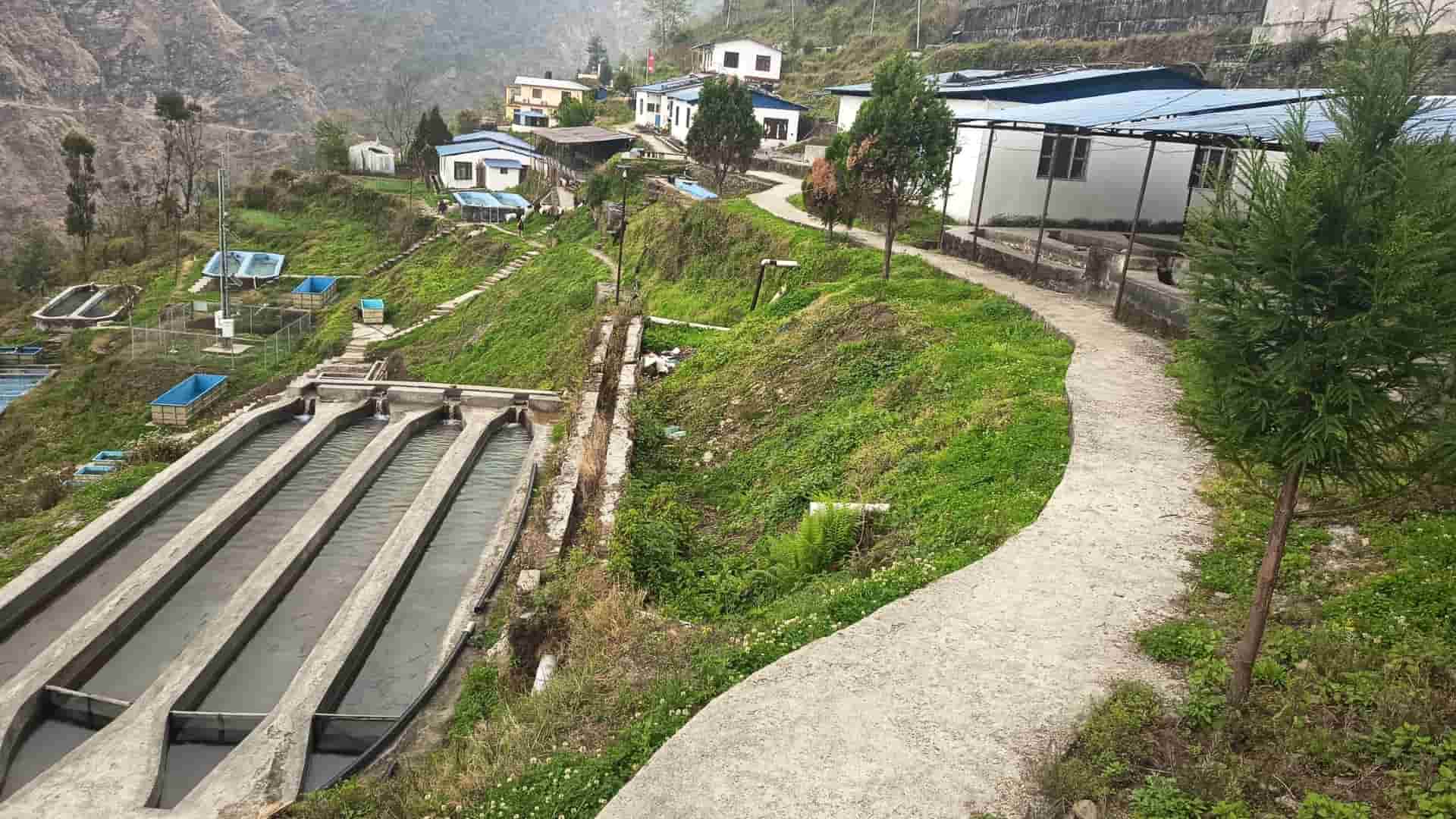
With improved production standards, trout eggs and fingerlings offer profitable returns, increasing farmer interest. From an initial price of NRs 300 per kilogram, the market value has now reached NRs 1,000. Trout farming requires water temperatures of 14–18°C, with eggs needing 9–11°C. At Dhunche, pure Himalayan water from the Trishuli River is piped over a kilometer to the center, exemplifying scientific water management.
The center, situated at 1,850 meters above sea level, includes two reservoirs, large and small ponds, totaling 69 water bodies. Currently, 275 broodstock fish are ready for egg production, with sufficient fingerlings stored for next year’s expansion. Over 111,000 fingerlings have already been distributed to farmers this fiscal year.
The popularity of trout cuisine is rising, particularly dishes served with buckwheat or maize-based local meals. Health experts highlight trout as a nutritious option suitable even for patients with diabetes and high blood pressure, while local resorts report growing consumer preference for trout.
The center represents a successful model of integrating modern science with Himalayan agriculture. Plans are underway to expand it as a hub for scientific research, training, and development. Rainbow trout farming in Rasuwa is expected to boost rural livelihoods, reduce poverty, create jobs, and strengthen the local economy, gradually extending from the far west to eastern Himalayan villages and shaping a new trajectory for Nepal’s high-altitude economy.