
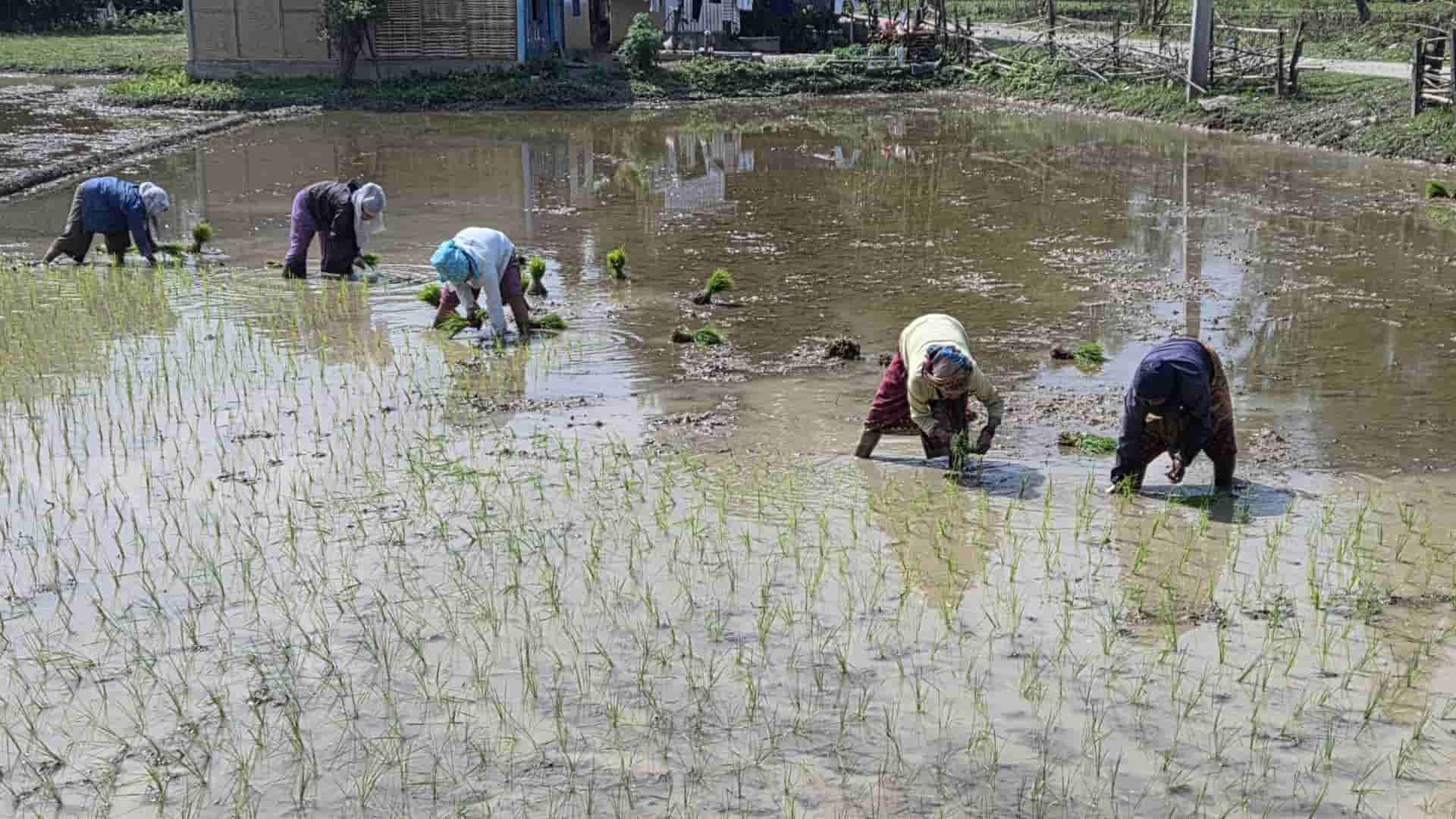

Farmers in Sunsari are currently busy transplanting Chait (spring) rice. Those with access to adequate irrigation facilities and wetlands are especially occupied with the seasonal planting.
In the district, rice is cultivated twice a year—during the Chait (winter/spring) and the monsoon seasons. Farmers are increasingly attracted to rice farming because it yields better returns than maize, and growing two rice crops annually allows them to sell one harvest for income.
According to Bhawana Majhi, a farmer from Ramdhuni Municipality–6, it is possible to grow up to three crops a year on the same land. She explained that timely transplantation of Chait rice leads to higher productivity. In addition to monsoon and Chait rice, farmers also cultivate crops such as buckwheat and mustard on the same fields.
Currently, Chait rice is cultivated on 4,600 hectares of land in the district. Last year, 23,160 metric tons of rice were produced from 4,006 hectares, according to Prabin Lal Shrestha, Information Officer at the Agriculture Knowledge Center.
He noted that Chait rice is gaining popularity among farmers because it is less prone to pests and diseases compared to monsoon rice and also offers better yields. The most commonly grown varieties in the district include Chaite-1, Chaite-5, and Hardinath-3. Favorable market prices have further encouraged farmers to adopt Chait rice cultivation.
Chait rice transplantation is particularly common in areas such as Barahakshetra Municipality wards 5, 6, and 7; Ramdhuni Municipality wards 6, 7, and 9; as well as Bhokraha and Itahari. According to Shrestha, regions with canal and irrigation access and less vegetable farming are more inclined toward this type of rice cultivation.
Dambar Majhi, a farmer from Ramdhuni–7, emphasized the importance of completing transplantation within the Nepali month of Chait for better yields. “We need to finish transplanting by around Chait 20 to 22. If planting is delayed beyond Chait, production decreases,” he said.