
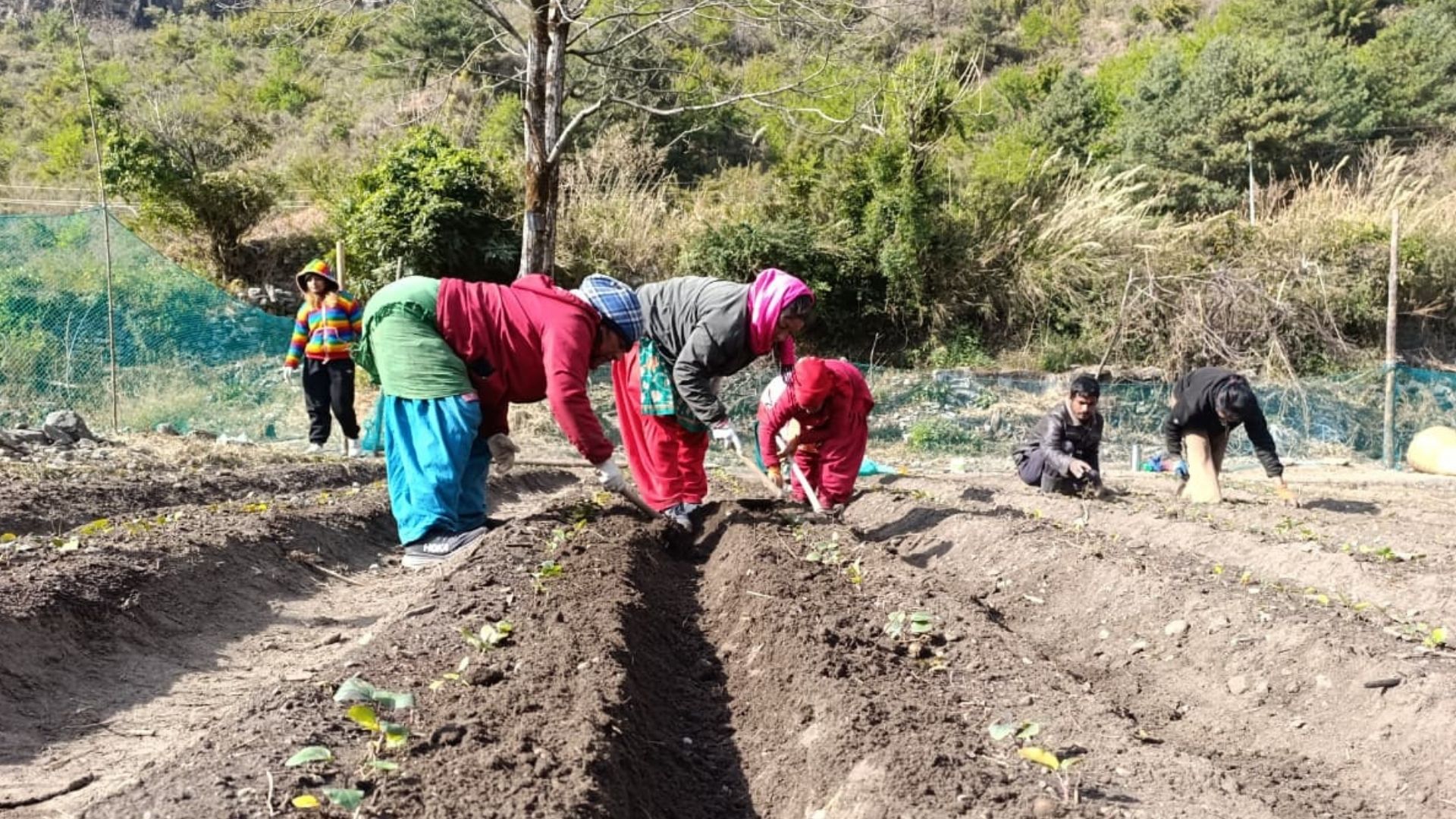

The Temperate Horticulture Development Center in Marpha-2, Gharapjhong Rural Municipality, Mustang, has started producing ‘Hybrid M9 Rootstock’ apple saplings this year using high-density cultivation technology. Through its tissue culture laboratory, the center is producing seeds of hybrid apples and planting them with high-density techniques to boost production.
So far, no other laboratory in Nepal has produced high-density hybrid apple saplings using tissue propagation technology. The center has now focused on producing saplings as a pilot project. While tissue culture laboratories in various parts of Nepal are used to propagate different fruit plants, this center has started producing M9 rootstock seeds specifically for hybrid apple saplings, according to Ashok Limbu, the center’s Biological Technology Officer. Attempts have been made in other labs in Nepal, but none have succeeded in propagation and development on the scale of this center.
The tissue culture laboratory at the center was established in 2021. For the first three years, the lab worked on disseminating hybrid apple propagation technology and developing various protocols for its use, Officer Limbu stated.
Following laboratory procedures, the center has also tested sapling production in the field, producing seeds for M9 rootstock saplings and establishing a model for high-density hybrid apple production management.
This year, the center plans to produce around 6,000 hybrid M9 rootstock apple saplings on one Ropani of grassland and another Ropani of land at Marpha through the tissue culture laboratory, Officer Limbu said.
For the fiscal year 2080/81, 300 saplings have already been produced in the lab as part of testing. Before distribution to farmers, the center intends to conduct thorough studies and research. Officer Limbu added that the center aims to make saplings available to buyers after detailed evaluation this fiscal year.
Due to limited infrastructure, the center has started with small-scale production. However, with sufficient high-tech greenhouses, the lab could potentially produce 50,000–60,000 M9 rootstock hybrid apple saplings in a short period.
In the second phase of this year, from the month of Jestha, the lab began producing seeds using different protocols for sapling cultivation. The center, for the first time in Mustang, is also preparing to test saplings at high, medium, and low altitude locations. Previously, M9 rootstock saplings were grafted with Gala, Fuji, Delicious, and Golden Delicious varieties, with testing still underway.
The tissue culture laboratory at the center uses a method where a part of the M9 rootstock is maintained in the lab and seeds are produced through various techniques. This technology allows large-scale propagation of high-quality and genetically uniform saplings.
High-density apple cultivation began in Mustang after 2013. As this method produces higher yields in smaller areas and shorter times, farmers are increasingly attracted to hybrid apple farming. The federal and provincial governments have supported the distribution of hybrid apples imported from Italy at subsidized rates, which has contributed to the expansion of hybrid apple cultivation in Mustang.
If the center succeeds in propagating its technology, hybrid apple saplings could become available at lower prices. Currently, an imported M9 rootstock costs over 1,000 NPR per sapling. Each M9 rootstock produced locally can be grafted with different apple varieties. Mustang has 837 hectares of apple cultivation, with 572 hectares currently yielding production. Across five rural municipalities, 62 hectares produced 250 metric tons of hybrid apples.