
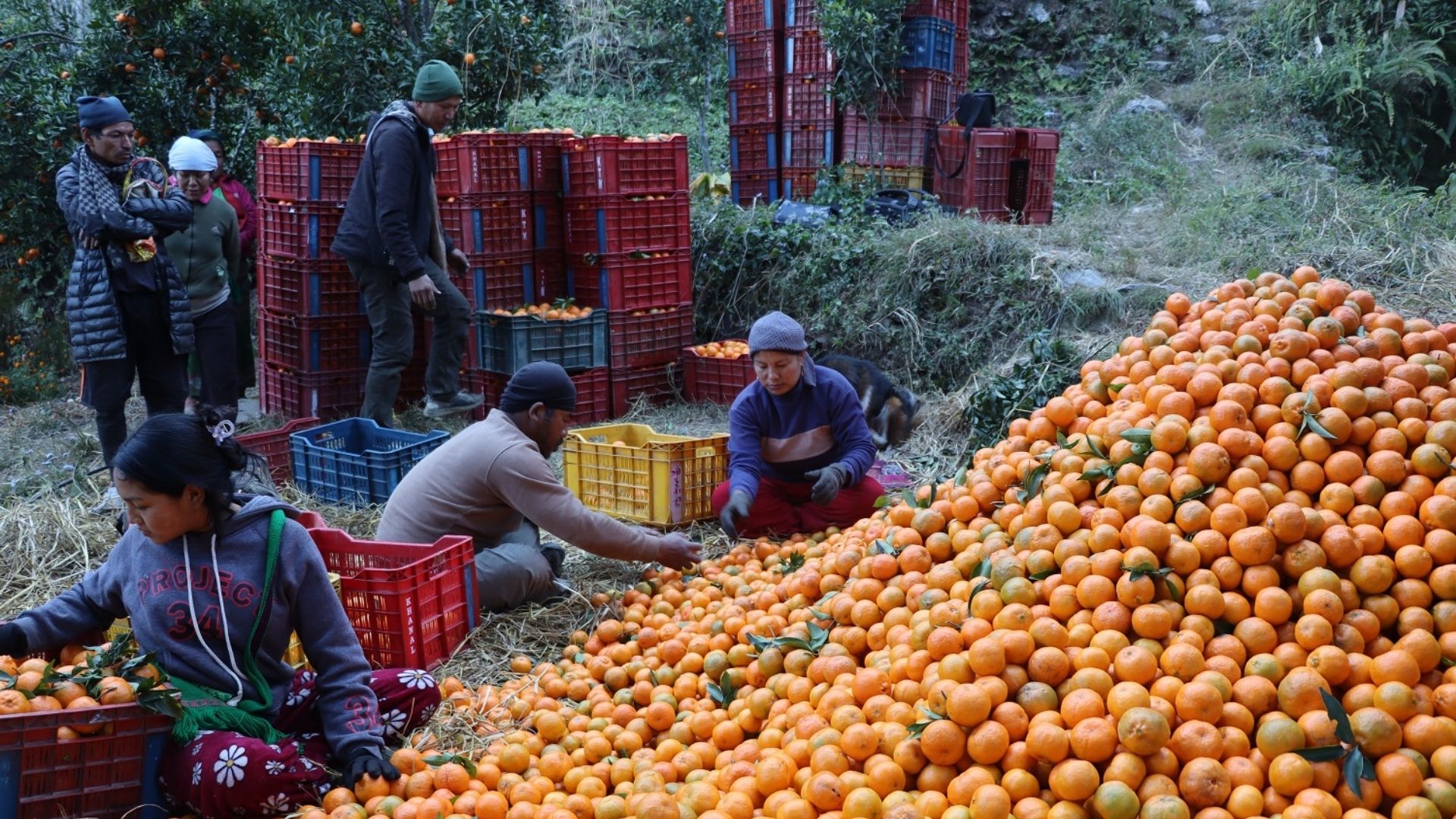

Orange production, one of the major cash fruit crops of Myagdi district, has declined this year. Although the cultivated area and market price of oranges have increased, productivity has decreased.
According to the District Agriculture Development Office, production has decreased by 5.56% compared to last year. Office Chief Sanjiv Bastola stated that despite the absence of diseases, pests, or natural disasters and favorable weather conditions, the reduced number of fruits on trees led to lower production.
“This year the weather was favorable. There were no pests or disasters, but the trees bore fewer fruits,” he said. “This is due to the natural characteristic of orange farming, where trees bear heavy fruit one year and less the next.”
Last year, oranges were cultivated on 425 hectares with an average productivity of 11.25 metric tons per hectare, producing 4,781 metric tons. This year, cultivation expanded to 430 hectares, but productivity dropped to 10.5 metric tons per hectare, with an estimated production of 4,515 metric tons.
Although preliminary data were prepared based on sample studies of orchards, the actual figures will be collected after all produce is sold. This year, oranges are being sold at an average price of NRs 70–75 per kilogram, about NRs 5 higher than last year.
Based on the estimated production and average selling price, total revenue from orange sales this year is expected to reach NRs 316 million.
According to official records, orange farming is conducted on 830 hectares in Myagdi, with more than 200 orchards spread across areas including Rakhuk, Marek, Surkemela, Barangja, Bhedabari, Arman, Runma, Bim, Okharbot, Takam, Ghatan, Pipley, Bhagwati, Beg, Dowa, Dosalle, Ghar, Bhrung Tatopani, Dana, and Narachyang.
Oranges from Myagdi are sold in markets such as Beni, Kathmandu, Pokhara, and Muglin. With improved transportation facilities, traders often come directly to orchards to purchase oranges. Support is being provided through the Prime Minister Agriculture Modernization Project, Agriculture Knowledge Center, and local governments in areas such as seedling distribution, technical training, orchard management, irrigation, and marketing.