
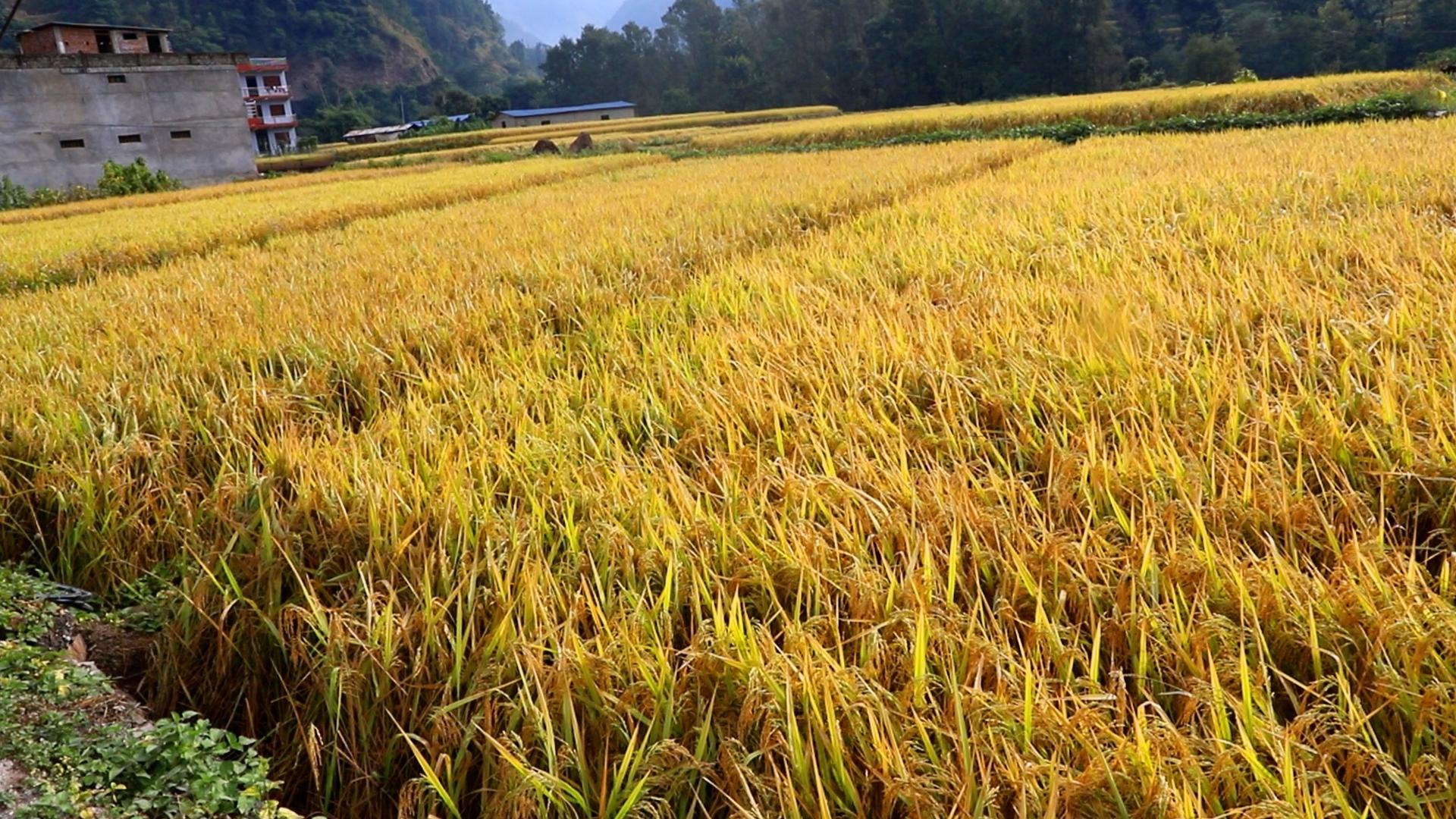

Rice production has risen in Baglung this year. According to the Agriculture Knowledge Centre, timely rainfall contributed significantly to the increase. Information Officer Pratibha Sharma stated that rice production reached 20,784.4 metric tons this year, compared to 20,000 metric tons last year, reflecting an increase of 84.4 metric tons.
Last year, production had declined due to root-rot disease that affected rice crops after transplantation. Sharma explained that reduced crop damage this year helped boost yields. Despite the increase, Baglung is still not self-sufficient in rice production. Farmers in the district grow varieties such as Khumal-4, Jetho Budho, Lumle-2, Jhinuwa, Khumal-11, Khumal Basmati-10, Marsi, and Jadan, among others. Recently, farmers have also begun cultivating hybrid varieties.
“Farmers’ interest in rice cultivation is increasing. Compared to last year, nearly 100 metric tons more rice has been produced this season. Timely rainfall and decreased incidence of root-rot disease supported improved production,” Sharma added. “Given the cultivated area, productivity is satisfactory.”
Only a few areas—such as Galkot, Resha, Sigana, Jaidi, and Chisti—have irrigation facilities; most parts of the district still lack irrigation. Despite heavy rainfall during harvesting this year, production was not affected, said Krishna Khatri, a farmer from Galkot-6, who reported an increase of three muri of rice compared to last year. Likewise, Narendra Paudel of Jaimini-7 said his field produced 16 muri of rice this year, up from 13 muri last year. He noted that delayed rainfall had caused irrigation challenges last year, but no such issues occurred this season.
Baglung has 46,148 hectares of arable land, but only 30,523 hectares are currently cultivated. Of this, only 6,148 hectares have access to irrigation facilities.